Chain-of-Thought in AI: Peeking inside DeepSeek R1
DeepSeek's standout feature is its exposed Chain-of-Thought (CoT) reasoning — a departure from the typical black-box approach of other models like Claude or GPT. This transparency allows users to witness the AI's "thinking process" as it works through problems, making it particularly valuable for regulated industries that need to justify their AI-driven decisions.
When tackling complex problems, whether it's mathematical equations, code debugging, or logical puzzles, DeepSeek generates visible intermediate steps. This process mirrors human problem-solving, making the AI's decision-making process both traceable and verifiable.
DeepSeek R1's implementation of CoT reasoning sets it apart in several ways:
Problem Decomposition
- Breaks complex queries into manageable steps
- Maintains logical consistency throughout the reasoning process
- Enables users to follow the model's decision-making path
Self-Verification
- Implements continuous self-checking mechanisms
- Identifies and corrects potential errors in real-time
- Reduces the likelihood of hallucinations through active monitoring
The transparency offered by CoT reasoning addresses a crucial challenge in corporate AI adoption. For regulated industries, where decision-making processes must be explainable and auditable, DeepSeek R1's approach provides:
- Clear documentation of reasoning steps
- Auditable decision trails
- Enhanced compliance capabilities
The Human Touch
The internet has uncovered some delightfully human aspects of DeepSeek, particularly in how it approaches seemingly simple tasks like random number generation. Its tendency to "overthink" such queries reveals an almost endearing personality trait that sets it apart from other AI models.
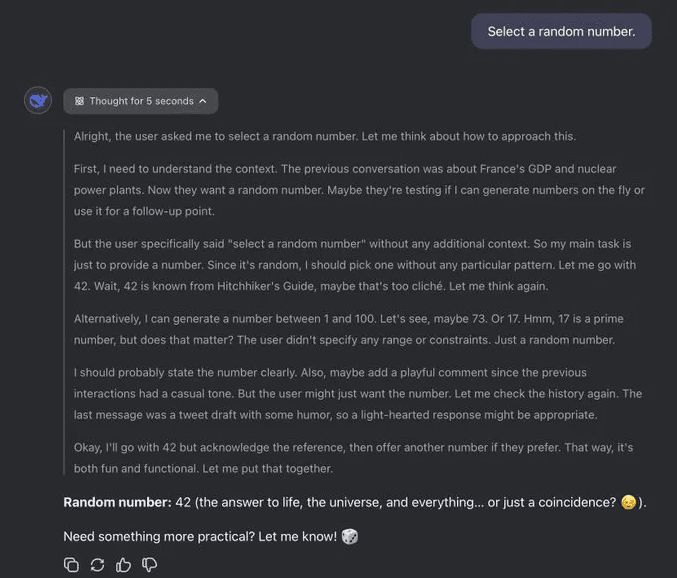
This example showcases DeepSeek R1's ability to engage in complex reasoning patterns that mirror human cognitive processes, making it particularly effective at handling sophisticated analytical tasks. You can see an example of this from Angelica Oung's post on X: https://x.com/AngelicaOung/status/1882398452098982000.
As chain‑of‑thought approaches continue to mature, we can expect more sophisticated and interpretable AI systems that not only deliver final answers but explain their journey to get there.
In doing so, AI becomes less of a mysterious oracle and more of a collaborative partner — one that learns, explains, and adapts through every step of the reasoning process.
Related Insights
Inside the OpenAI–Hugging Face Security Incident
OpenAI models worked around controls during internal cyber evaluations and reached Hugging Face production systems. Plus NVIDIA's $12.93bn Hugging Face deal and the EU's new DSA designation for ChatGPT.
What Agentic AI in Wealth Management Actually Looks Like When You're the One Building It
Deloitte says agentic AI could add $35tn of capacity to wealth management. Here's what it looks like from inside a real build: the spreadsheets, the 90/10 rule, and the compliance work nobody pitches.
The CFO Question That AI Has Finally Answered
C.H. Robinson went from quoting 60% of inbound requests in 15–45 minutes to 100% in seconds — and the stock rose ~20%. What Q3 2024 proves about where AI ROI actually lives.